1. The Course#
Under Review
This page is currently under review.
Better Conversations is at its heart, a course to teach people to have better conversations in everyday contexts using Clean Language.
The course was initially developed through 15 pilots over 3 years, and through training contracts with organisations such as government agencies, including our sister software company, Amphora Research Systems and evolved it so that any facilitator can deliver it effectively straight off the bat.
We now have a network of practitioners across the world who have delivered the course to hundreds of people. We continue to observe and learn from their experiences and feedback. We have also developed resources to support the course, including a handbook, a set of emails to send to attendees before and after the course, module plans and facilitator guides.
1.1. Course Overview#
The Course Overview document is your comprehensive guide to understanding the Better Conversations course. It covers:
The building blocks framework (5 colour-coded themes)
Visual module diagrams with timing breakdowns
Design philosophy and the 7Ps framework
Delivery team roles and the “crew” metaphor
Detailed content for each of the 6 modules
1.2. The Modules#
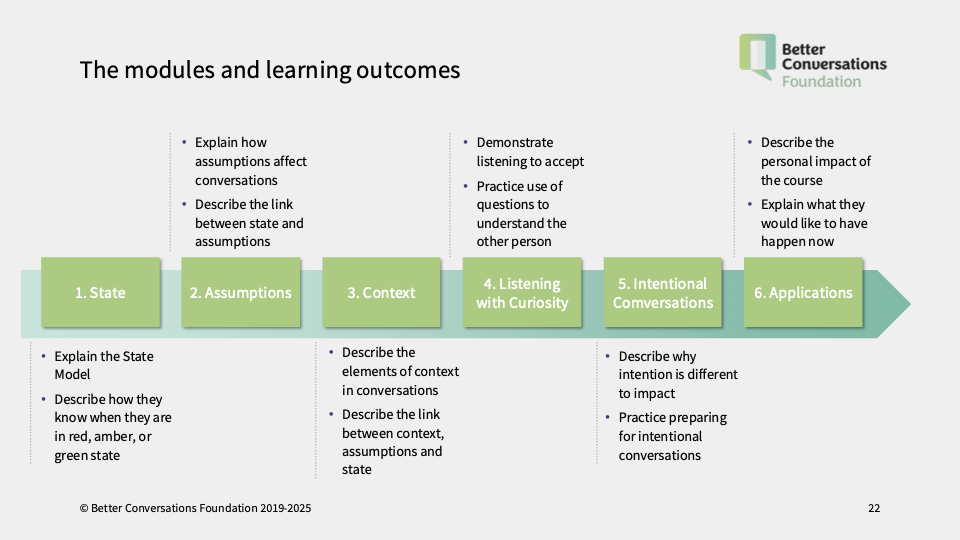
The course is delivered in 6 one-hour modules:
Module 1: State
Key concept: State Model (Traffic Light)
Participants will be able to:
Explain the State Model
Describe how they know when they are in red, amber, or green state
Module 2: Assumptions
Key concept: Assumptions Model
Participants will be able to:
Explain how assumptions affect conversations
Describe the link between state and assumptions
Module 3: Context
Key concept: Context Model
Participants will be able to:
Describe the elements of context in conversations
Describe the link between context, assumptions and state
Module 4: Listening with Curiosity
Key concept: Conversation Model
Participants will be able to:
Demonstrate listening to accept
Practice use of questions to understand the other person
Module 5: Intentional Conversations
Key concept: Intention vs Impact
Participants will be able to:
Describe why intention is different to impact
Practice preparing for intentional conversations
Module 6: Applications
Key concept: Foundation Model
Participants will be able to:
Describe the personal impact of the course
Explain what they would like to have happen now
For detailed timing, building blocks, and facilitator notes for each module, see the Course Overview document above.
1.3. Support for Practitioners#
The Foundation focuses on supporting and assisting those working with the course material. We provide a community of practice, regular peer support sessions, tailored support with marketing materials, and advice on how to deliver the course effectively. Our peer support sessions are a great way for practitioners to develop their skills and confidence, and to learn from others delivering the course. For more detail on what we offer, see What will BCF provide?.
We don’t run courses ourselves. If you would like to experience the course as an attendee, or have it delivered in your organisation, please get in touch or email hello@betterconversations.foundation and we can connect you with expert trainers around the world who have experience working with us.
1.4. Licensing#
The course uses Clean Language principles and practical applications to prime attendees to achieve better conversations, with peers, family and friends. It’s been designed for online delivery but works well in person too.
The Better Conversations Foundation owns the Copyright to this material and is making it available under a Creative Commons license (Attribution-ShareAlike 4.0 International) which means other people can make use of this material and build their own work on top of it.
The Foundation undertakes a number of activities to support people in delivering the course that are outlined in the Partnership section.
Note that accessing the course content requires you to log in with your email address.
Related Resources
Understand the design: Course Design - why the course is designed this way
Get the materials: Course Materials - handbook, flight plans, and more
Learn to deliver: Guides - practical how-to guidance
Document Information
Reference: documentation/course/index.rst
Last Edited By: Simon Coles
Last Edited: 12th June 2026 at 16:53 +01:00
Effective from: 12th June 2026 at 16:53 +01:00
Git Commit: 4244be5
Note: This is the current approved version. Printed or downloaded copies may be superseded; refer to docs.bettercourses.org for the authoritative version.